Engineering the Peak – What Sets Surf Lakes’ Waves Apart?
Each swell at a Surf Lake is created in a deep central core and behaves as traditional surface gravity wave, making them ideal for surf parks.
“From a technology point of view, they have one incredible fundamental asset. The wave is ridiculously good! The quality of that wave is, at the moment, unparalleled.”
Kale Brock, Filmmaker and Surf Coach
At Surf Lakes, we are committed to making the most “ocean-like” waves in the industry. Our prototype facility provided strong evidence and reviews of this goal, backed by those who have surfed a “Surf Lakes” wave. You can hear their thoughts here.
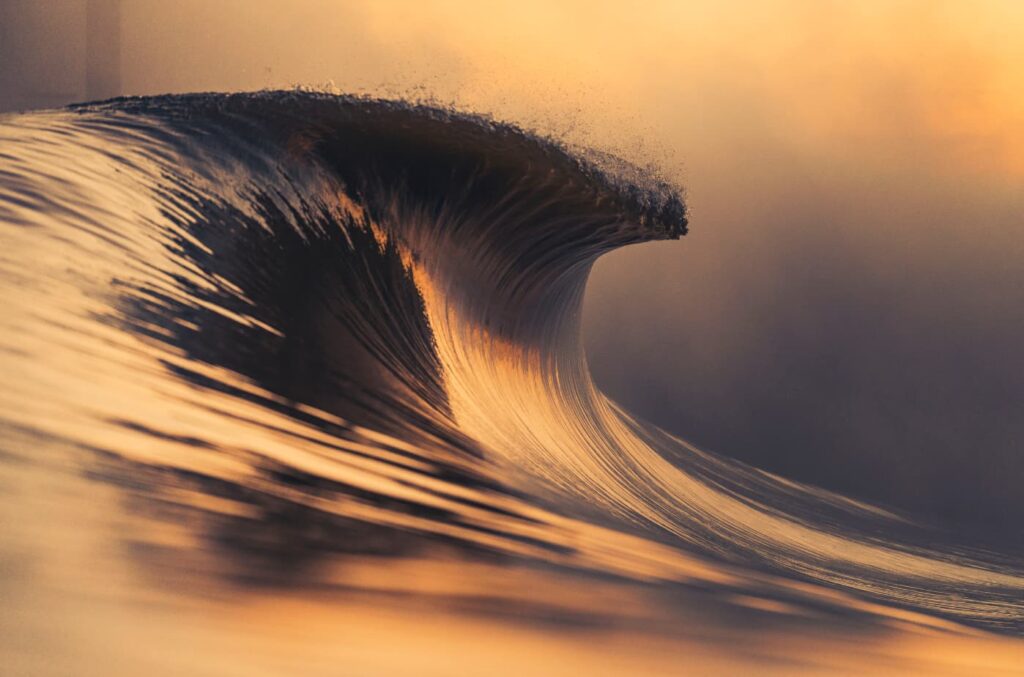
Above: Sunset at Surf Lakes slab; our best impression of nature. Shot by Rambo Estrada
The ‘Feel’
Surfer reviews of surf parks often refer to how “ocean-like” the wave feels, and according to Surf Park Central’s 2023 Consumer Trends Report (based on statistics from Surfline/Wavetrak, Inc.), wave quality is the single most appealing attribute to visitors at any surf park.
The ultimate value proposition of a surf park is offering the most natural experience with the convenience of on-demand, replicable quality. For a surf park to be a worthy training ground, the wave form should resemble nature so that surfers can transfer skills from surf parks to the ocean.
Waves In Nature: Understanding The Basics
Waves in nature are created when wind blows over the ocean surface, creating ripples. With enough wind, these ripples form into deep-water waves far offshore and move freely across the ocean. As they approach land and change to transitional waves, they start to interact with the ocean floor, which makes them slow down, steepen and eventually break into surfable waves.
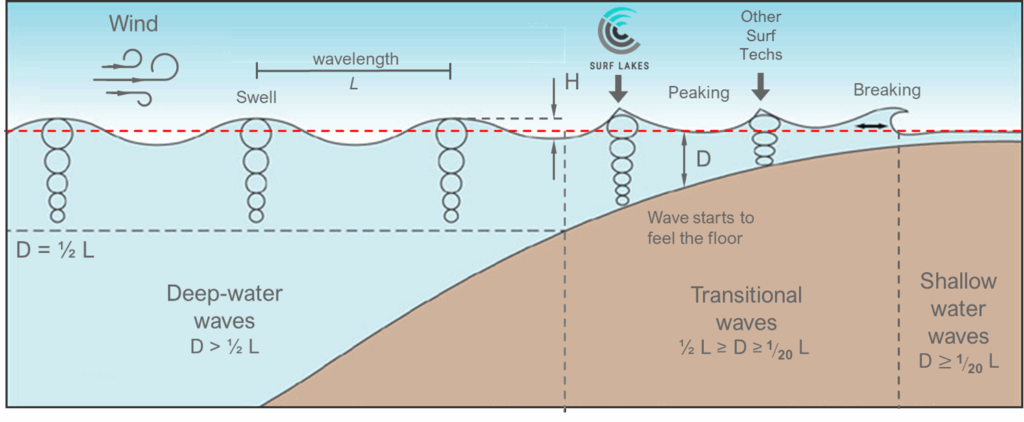
Above: Surf Zone Hydrodynamics broken down from elemental influences to mathematical formulas
Surf Zone Hydrodynamics is the study of ocean or gravity waves in the transition and shallow zones. Understanding wave formation allows Surf Lakes to engineer the shape of the floor “bathymetry” to create desired wave types, whether that’s a spilling beach break or a hollow barreling reef break.
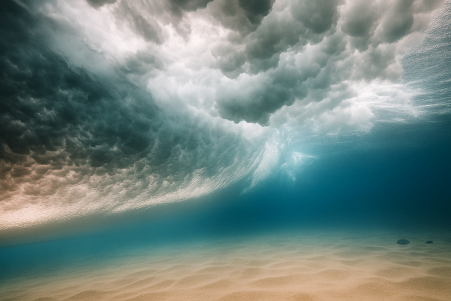
Above: An ocean image of surf zone hydrodynamics in action
Surf Park Waves
Surf parks strive to replicate ocean gravity waves by imparting a mechanical force on the water. There are currently five main types: standing, foil, levers/paddles, pneumatic chamber and plunger. Many of these first-generation technologies work in the same way that a boat creates a bow wave. The manufactured wave motion and speed are directly tied to the motion and speed of the mechanical generating device. They produce fun waves, but waves generated this way use a sort of Kelvin wave concept or produce solitary waves, which have a shorter wavelength (L) and period (T) for a given wave height (H), compared to traditional ocean gravity waves. Surf Lakes uses a unique patented displacement method that produces a different type of wave from anything else in the industry.
Surf Park technology and wave characteristics are often proprietary (trade secrets), meaning published data for use in theoretical models is therefore not readily available. This lack of transparency makes direct wave comparisons between surf park technologies difficult, which is why the “feel” and rider experience are such a key indicator of a wave’s value.
Surf Lakes could see certain limitations to some first-generation wave technologies and aimed to not just imitate an ocean wave but use a deep understanding of wave formation to revolutionize a next-generation novel design.
Surf Lakes DeepSwell Approach
Surf Lakes waves are formed in a smooth and harmonic motion. Both peak and trough form in balance, creating an “ocean-like” set of waves with a visible trough before the crest.
“Surf Lakes is the only wave company producing real surface gravity waves that provide a realistic representation of a real wave set in the ocean. These waves have an established wave trough and crest structure, which provides the crisp, steep pocket sections that you normally only associate with real ocean waves.“
Quote from: Simon Mortensen, Msc, CPEeng, Principal Coastal Engineer, DHI Water & Environmental
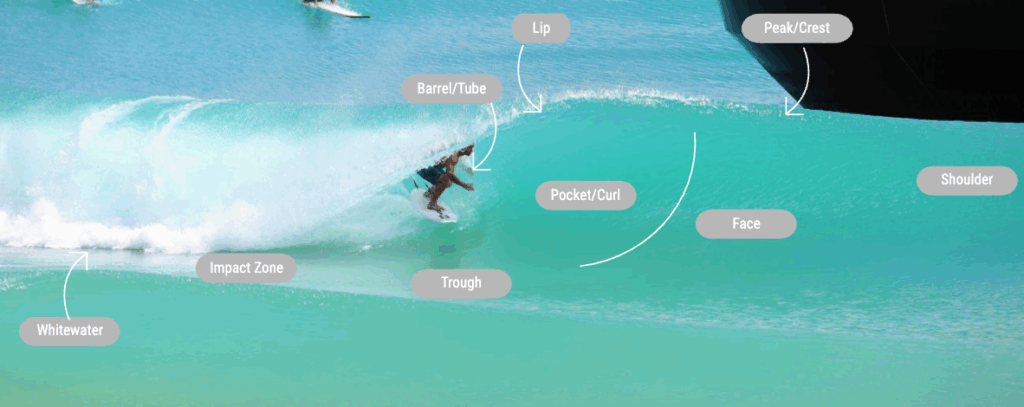
Above: Occy threading one at his namesake peak, which he helped Surf Lakes design
Each swell at a Surf Lake is created in a deep central core and behaves as a traditional surface gravity wave, making them ideal for surf parks. By combining knowledge of traditional surf zone hydrodynamics and Surf Lakes technology, our engineers can accurately predict the wave types produced and modify the lake bathymetry accordingly.
Surf Lakes Engineer, Kit Sidwell, breaks this down further in a video here.
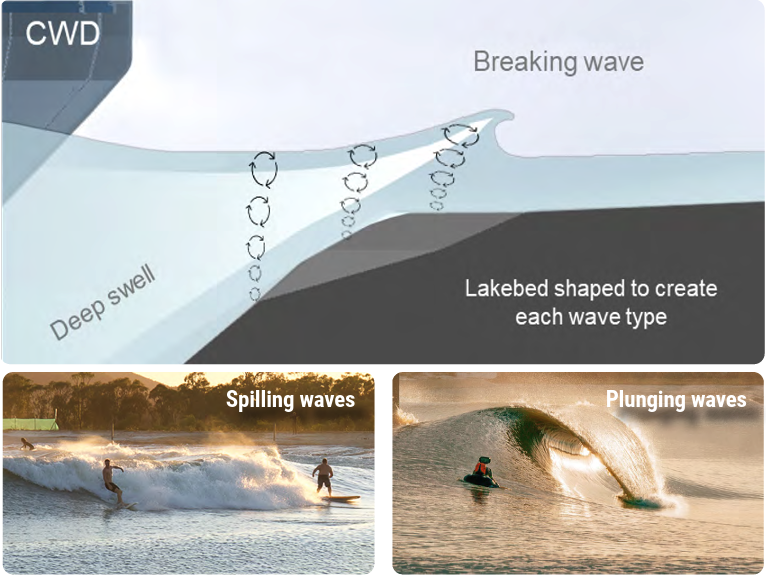
Above: The elements that help Surf Lakes engineer specific waves and some examples of the end product
Can We Quantify Wave Quality?
Wave size has historically been the standard forecasting metric that gets surfers excited, although energy has recently emerged as a more specific forecasting tool for wave quality. Swell energy can be an informative tool as it brings wave height (H), period (T) and swell direction (θ) into the equation.
However, energy in a single wave peak, without a natural period, is just a function of wave height and is much less useful for comparing wave quality in surf parks. A 3ft wave at your local break and at a surf park may have the same wave energy, but they can feel very different. That difference is the wave’s power.
The same height wave with more wave power has more “push,” enabling surfers to perform more maneuvers.
Like any tool, wave power doesn’t tell you everything, but it can be helpful for comparing wave quality in surf parks. Surf zone hydrodynamics shows that water depth at breaking point strongly influences wave power, as it governs both wavelength and speed. Generally, a wave breaking in deeper water carries more power than the same height wave breaking in shallower water.
This is where Surf Lakes stands alone.
Using Depth To Our Advantage
Surf Lakes waves consistently break in deep water. A 1.8 m (6 ft) height wave at Occy’s Peak (Surf Lakes expert wave) breaks in water deeper than 2 m (7 ft). This wave carries 40% more power than the same height wave breaking in waist-deep water.
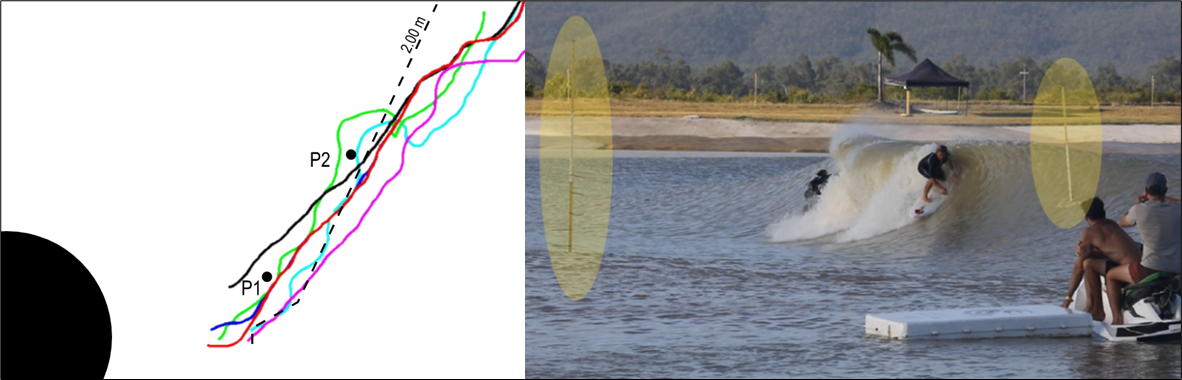
Above: Deeper Water = Safer Surfers
The Future Looks Bright
While much of the industry focuses on delivering the highest surfer capacity or lowest energy usage (areas that Surf Lakes caters to exceptionally well), we believe wave quality will always be the key driver for surf park adoption. Surf Lakes aims to elevate the market expectation on wave quality in an artificial environment.
We also have one eye on the inevitable growth of surfing. History repeatedly shows that surfers will always search for bigger and better-quality waves, and Surf Lakes may well be the only technology capable of scaling up economically.
While bigger waves are currently not yet in demand from developers, we know as the industry continues to grow, our strategic position to remain at the forefront of delivering exciting waves will be pivotal in future-proofing the business while continuing to deliver pure stoke.